
Empowering Clinical Confidence in CAD Screening
Discover HeartForce’s evidence-backed tools and research designed for general practitioners, family doctors, cardiologists, sport physicians, paramedics, pharmacists, and emergency clinicians.
CardioClin™ is built for today’s frontline professionals, enabling fast, validated, and effortless CAD screening for both symptomatic patients and high-risk individuals with multiple CAD-associated risk factors.
It supports preventive care, improves triage accuracy, and helps clinicians act sooner to reduce unnecessary testing and improve outcomes.
Fast.
Validated.
Effortless.
CardioClin™ Across Care Settings

Primary Care
General practitioners are often the first to assess patients with chest discomfort, fatigue, or cardiovascular risk factors. Yet traditional tools make it difficult to identify those developing CAD before symptoms intensify.
CardioClin™ provides a quick, non-invasive risk assessment in just 60 seconds, empowering earlier, preventive screening for high-risk patients with multiple CAD-associated risk factors and improving referral precision for those presenting with symptoms.

Pharmacies
Pharmacies play a growing role in community-based preventive care, but most available tools focus only on blood pressure or cholesterol checks.
CardioClin™ enables pharmacists to perform quick, evidence-based cardiac risk assessments, broadening their preventive services and helping detect CAD risk in individuals with multiple cardiovascular risk factors.

Ambulances & Mobile Care Units
Paramedics often face diagnostic uncertainty when evaluating chest pain or shortness of breath. Early ischemic changes may not appear on standard ECGs.
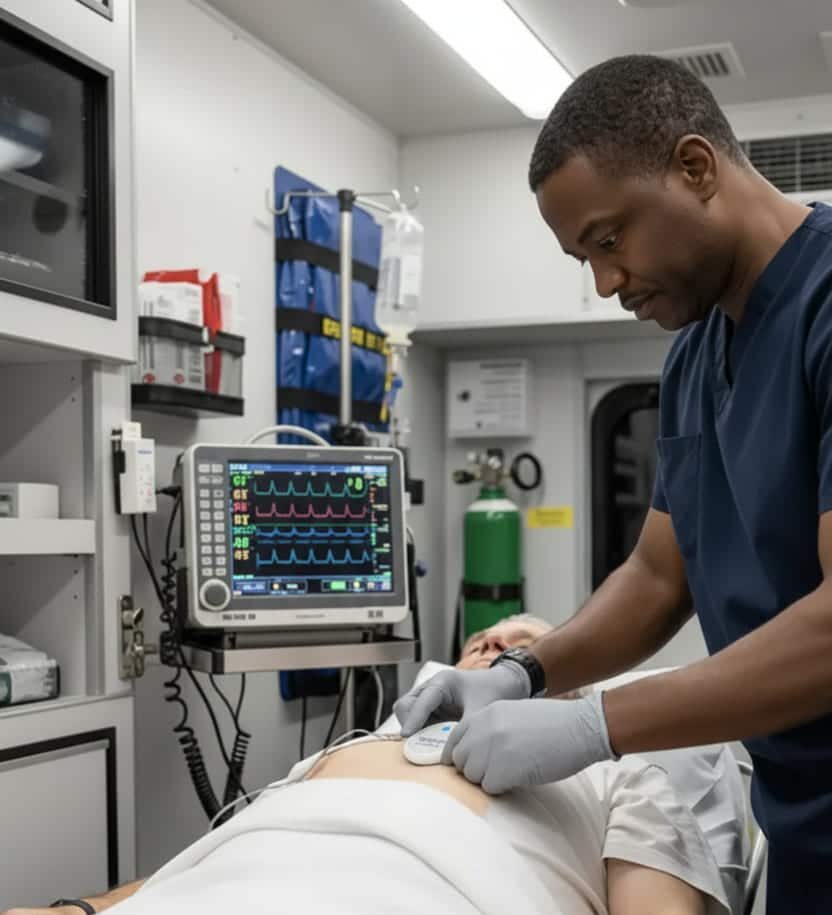
CardioClin™ provides a rapid, on-site CAD risk assessment that supports triage decisions, helping emergency teams identify high-risk patients faster and avoid unnecessary transports for low-risk cases.

Occupational & Institutional Medicine
In occupational and institutional health programs, cardiovascular screening is often limited to basic metrics.
With CardioClin™, occupational health providers can integrate non-invasive, preventive CAD risk assessments into routine employee check-ups, identifying high-risk individuals with multiple CAD-associated risk factors earlier and supporting workforce wellbeing.

Hospital Emergency Centers
Emergency departments see thousands of patients presenting with chest pain, yet up to 80% test negative for CAD¹.
CardioClin™ supports safe rule-out in low-risk patients (NPV ~ 95 %)²,³ reducing unnecessary imaging, anxiety, and admissions. It can also be used preventively during follow-up or discharge planning for high-risk patients with multiple CAD-associated risk factors.

Cardiology Departments
Cardiology units manage high referral volumes, many of which prove non-obstructive.
CardioClin™ enhances efficiency by pre-screening lower-risk individuals and extending cardiology’s reach to patients with multiple CAD-associated risk factors, enabling earlier intervention and optimized use of advanced imaging resources.
The Science Behind Our Technology
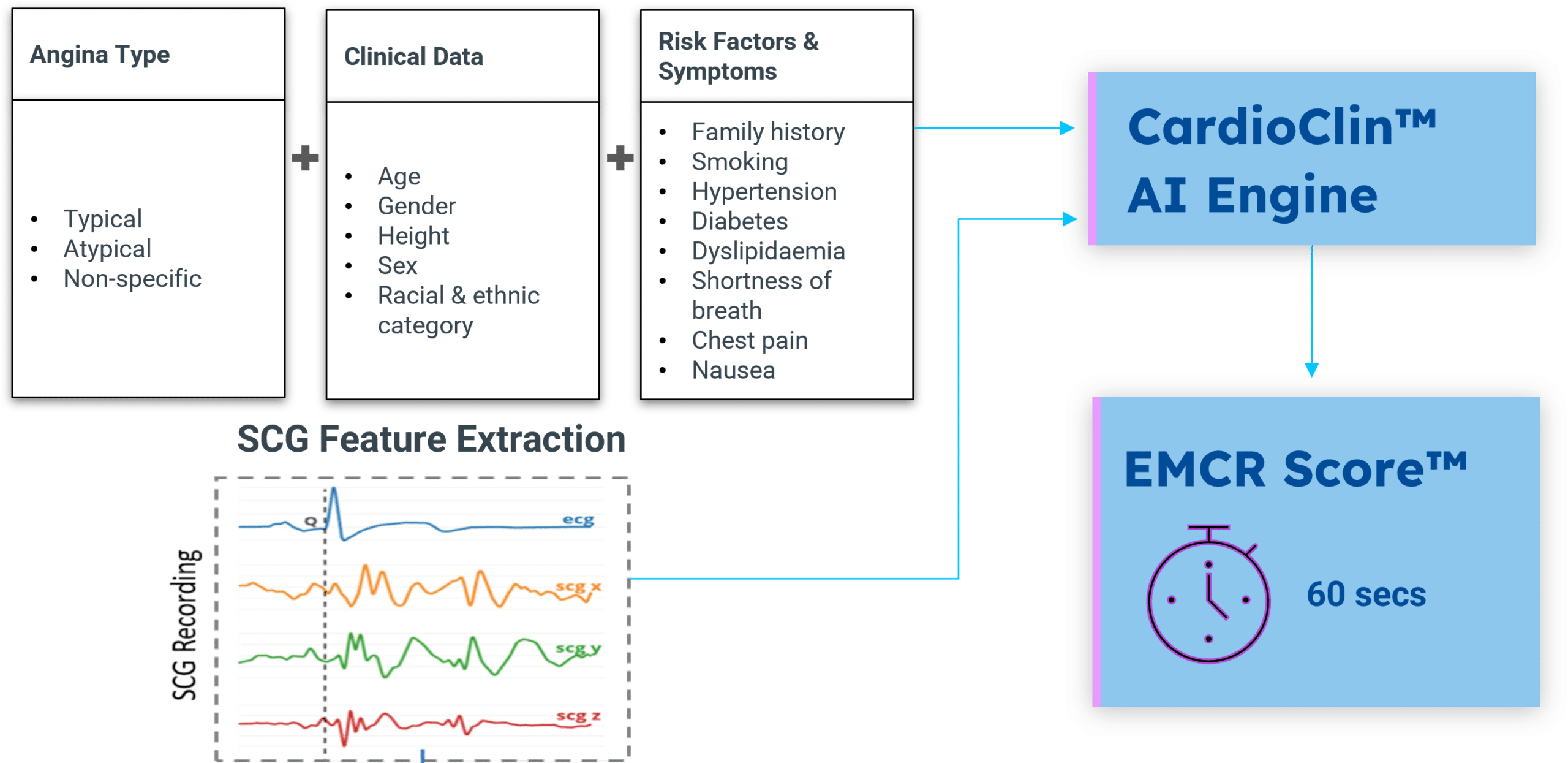
At the core of CardioClin™ is the Electro-mechanical CAD Risk (EMCR) Score™, powered by seismocardiography, a non-invasive technology that records subtle chest vibrations caused by cardiac motion.
By translating these mechanical heart signals into an individualized CAD risk score, CardioClin™ detects early electro-mechanical changes linked to coronary artery disease, supporting more timely and confident clinical decisions.
References
- Therming C, Galatius S, Heitmann M, Højberg S, Sørum C, Bech J, et al. Low diagnostic yield of non-invasive testing in patients with suspected coronary artery disease: results from a large unselected hospital-based sample. Eur Heart J Qual Care Clin Outcomes. 2018 Oct 1;4(4):301–308. doi: 10.1093/ehjqcco/qcx048
- Dehkordi P, Tavakolian K, Xiao ZG, Khosrow-Khavar F. Introducing the Electromechanical Risk Factor Score derived from seismocardiography for estimating the likelihood of coronary artery disease. In: Computing in Cardiology (CinC); 2023. Availeble from: https://ieeexplore.ieee.org/abstract/document/10364231
- Dehkordi P, Tavakolian K, Xiao ZG, Yuldashov A, Khosrow-Khavar F. Assessing coronary artery disease risk using seismocardiography in patients with chest pain. In: 2025 IEEE Engineering in Medicine & Biology Society (EMBC); 2025 July 15–19; Milan, Italy. IEEE; 2025

