AI-Driven CAD Risk Assessment and Triage with CardioClin™
Fast.
Non-invasive.
Radiation-free.
60 secs
test time.
What Is the CardioClin™ Product?
A Smarter Way to Screen for CAD
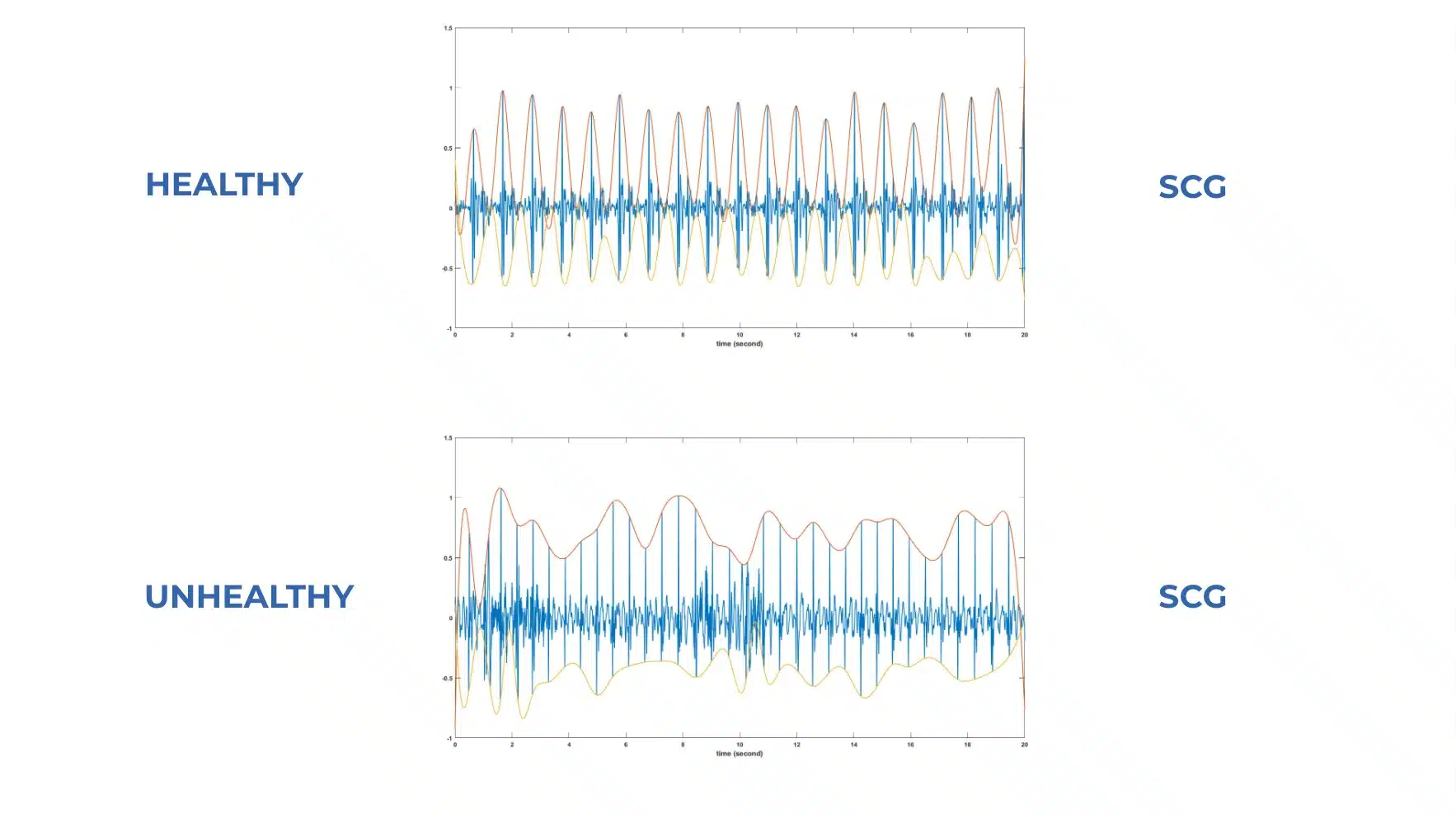
Traditional tools like PTP and RF-CL rely only on age, sex, and symptom patterns to generate an average probability of disease¹. CardioClin™ goes further by capturing each patient’s actual heart signals.
By integrating these vibration signals (SCG) with known risk factors, our EMCR Score™ delivers a truly patient-specific risk assessment, not just the population average.
The result? An AI-driven, personalized Electro-mechanical CAD Risk Score (EMCR Score™).
How CardioClin™ Compares to Traditional CAD Tests
The following table compares CardioClin™ against traditional CAD screening tools, highlighting how our fast, non-invasive technology overcomes today’s diagnostic gaps and enables earlier, more efficient CAD risk detection.
CardioClin™ |
|---|
60 secs test time |
Patient is symptomatic & high-risk |
Non-invasive, no radiation |
High sensitivity/NPV validated |
No special equipment/staff |
Low cost |
Reduces unnecessary referrals |
Excellent, easy to integrate |
Detects dysfunction before symptoms |
Highly portable |
Stress ECG |
|---|
30-60 mins test time |
Patient is primarily symptomatic |
Exercise stress, IV prep |
Moderate accuracy, operator-dependent |
Requires treadmill/echo |
Moderate cost |
High rate of false positives/negatives |
Limited usability in primary care |
Limited early detection |
Not portable |
Calcium Score (CACS) |
|---|
10-15 mins test time |
Patient is typically asymptomatic |
Radiation exposure (low dose CT) |
Detects calcified plaque only |
Requires CT scanner |
Moderate to high cost |
Often leads to downstream diagnostics |
Rare in GP practices |
Detects calcification only |
Not portable |
Why Choose CardioClin™?
- Test results in just 60 seconds, enabling immediate triage
- No needles, radiation, or discomfort
- Suitable for symptomatic and high risk patients with multiple CAD-associated risk factors
- Outperforms conventional screening tools like stress ECG and calcium scoring in identifying and ruling out CAD risk
Accurate, Affordable, and Fast
Product Specifications
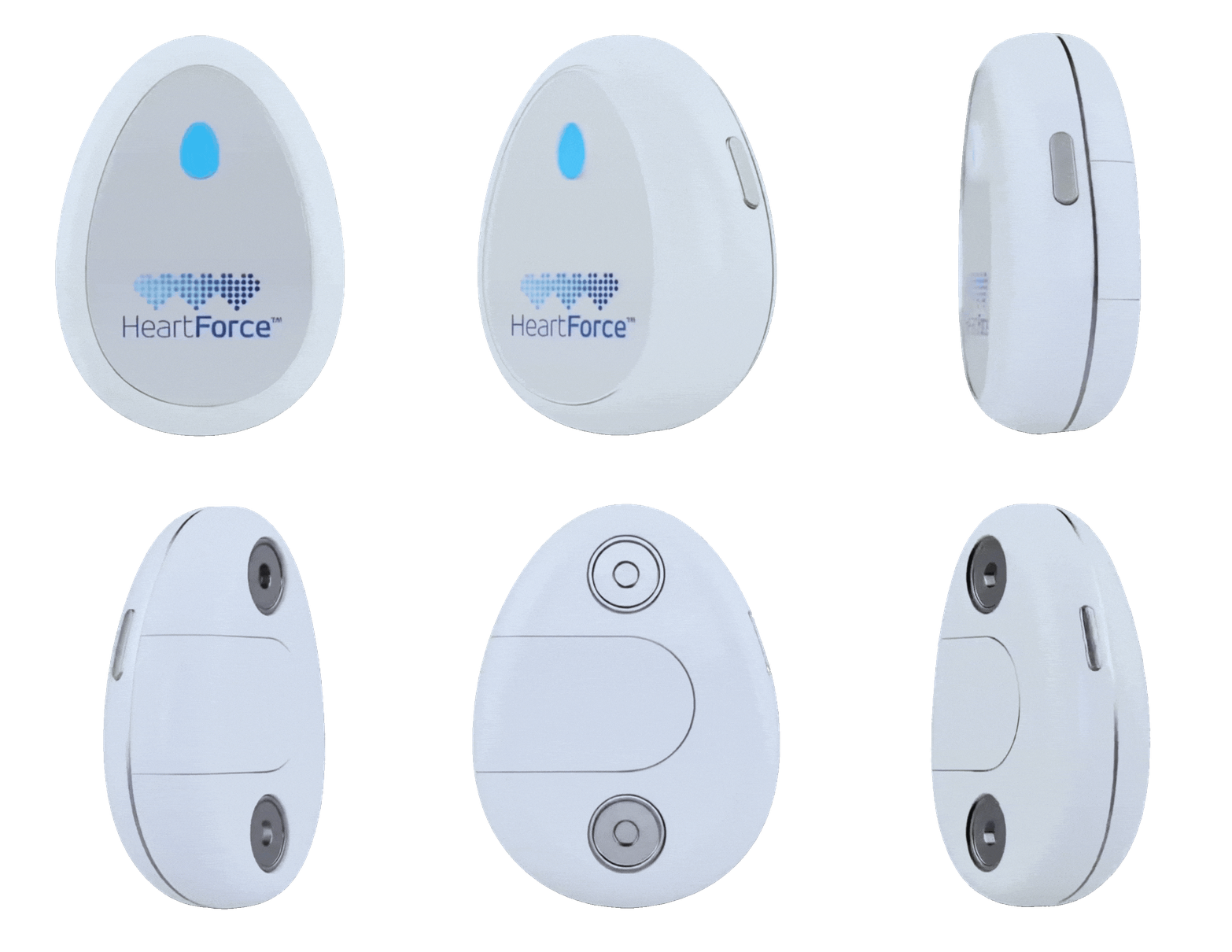
- Size: 4.0 x 6.0 x 2.0 cm
- Weight: 35 grams
- Sensors: 6-D low-noise, high-sensitivity cardiac motion sensor ECG: 1-channel
- ECG: 1-channel ECG with stainless steel electrodes
- Connectivity: Bluetooth 5.0
- Power: CR2032 lithium 3V coin cell battery
CardioClin™ Designed for Every Stakeholder
For Clinicians
CardioClin™ is:
- Portable and easy to use, which means no special training or equipment required
- A triage-ready tool that fits into primary care, pharmacies, ambulances, occupational & institutional medicine settings, hospital’s emergency centers and cardiology departments
- Clinically validated, with strong performance in detecting and ruling out CAD risk
- Immediate insights mean faster, more confident clinical decisions, without burdening diagnostic labs.
Understand how our Electro-Mechanical CAD Risk Score technology, including seismography, supports you in confident CAD screening.
For Investors
Driving scalable adoption and long-term market value.
- Fast, non-invasive 60-second CAD-risk score enabling broad screening across primary care, acute and telehealth settings.
- Clinically validated against CCTA/ICA with strong evidence and 38%² ³ fewer false positives than conventional screening tools.
- Efficient 5–10 minute workflow that reduces unnecessary imaging and improves triage, supporting high-volume deployment.
- Low-cost, infrastructure-light solution with HIPAA/GDPR-aligned data handling, ideal for scalable, sustainable commercial models.
A proven, efficient platform built for population-level impact and global growth.
Ready to Transform Your Approach to CAD Screening?
References
- Nelson, A. J., Ardissino, M., & Psaltis, P. J. (2019). Current approach to the diagnosis of atherosclerotic coronary artery disease: More questions than answers. Therapeutic Advances in Chronic Disease, 10, 1–20. https://doi.org/10.1177/2040622319884819
- Dehkordi P, Tavakolian K, Xiao ZG, Khosrow-Khavar F. Introducing the Electromechanical Risk Factor Score derived from seismocardiography for estimating the likelihood of coronary artery disease. In: Computing in Cardiology (CinC); 2023. Availeble from: https://ieeexplore.ieee.org/abstract/document/10364231
- Dehkordi P, Tavakolian K, Xiao ZG, Yuldashov A, Khosrow-Khavar F. Assessing coronary artery disease risk using seismocardiography in patients with chest pain. In: 2025 IEEE Engineering in Medicine & Biology Society (EMBC); 2025 July 15–19; Milan, Italy. IEEE; 2025