
Frequently Asked Questions for Healthcare Professionals
Everything You Need to Know About CardioClin™
Whether you’re considering CardioClin™ for your clinic or already using it, this section addresses the most frequently asked questions by healthcare professionals. From clinical validation and ease of use to safety, maintenance, and future updates. Get clear answers on how CardioClin™ supports effective coronary artery disease (CAD) screening in your everyday practice.
1. Clinical Effectiveness & Accuracy
Is CardioClin™ designed to replace existing diagnostic tools?
No, the CardioClin™ is a screening device. Our device effectively screens at-risk patients for CAD and helps clinicians determine who should be referred for further diagnostics such as CTA, functional testing, or ICA. CardioClin™ supports clinical decision-making by estimating each patient’s probability of CAD.
What clinical evidence supports the accuracy and reliability of the CardioClin™ device?
Multicenter clinical studies have validated CardioClin™ against gold-standard diagnostic tools, including Invasive Coronary Angiography (ICA) and Coronary Computed Tomography Angiography (CCTA). CardioClin™ demonstrated consistent performance across diverse patient populations.
What are the performance metrics for CardioClin™?
Across our entire dataset of 2,110 individuals, CardioClin™ achieved 90% sensitivity, 66% specificity, 58% positive predictive value (PPV), and 95% negative predictive value (NPV) in validation studies.
Has CardioClin’s performance been validated in peer-reviewed studies?
Yes, experts have presented CardioClin’s diagnostic performance and clinical value at major cardiology conferences and published their findings in peer-reviewed journals.
How does CardioClin™ compare to other diagnostic tests used today?
CardioClin™ could replace stress ECG because of its superior ability to rule out disease and reduce the number of false positives. Despite having similar technical characteristics with Calcium scoring, it is fast, easy to accomplish, and there is no need for a specialist (i.e. radiologist) to conduct the test suitable for the first line of cardiac screening within the healthcare system.
How does CardioClin™ compare to other screening models such as PTP or RF-CL?
Traditional pre-test probability (PTP) and RF-CL models are limited to symptomatic patients. In contrast, CardioClin™ has been validated in both symptomatic patients and high risk patients with multiple CAD-associated risk factors. It consistently demonstrates higher diagnostic accuracy, with stronger sensitivity and improved specificity, making it a more versatile screening tool for CAD risk stratification.
2. Technology & Workflow Integration
How long does it take to perform a CardioClin™ test?
A full assessment, including device setup, signal acquisition, and automated risk analysis, can be completed between 5-10 minutes (end-to-end).
What equipment is required to use CardioClin™?
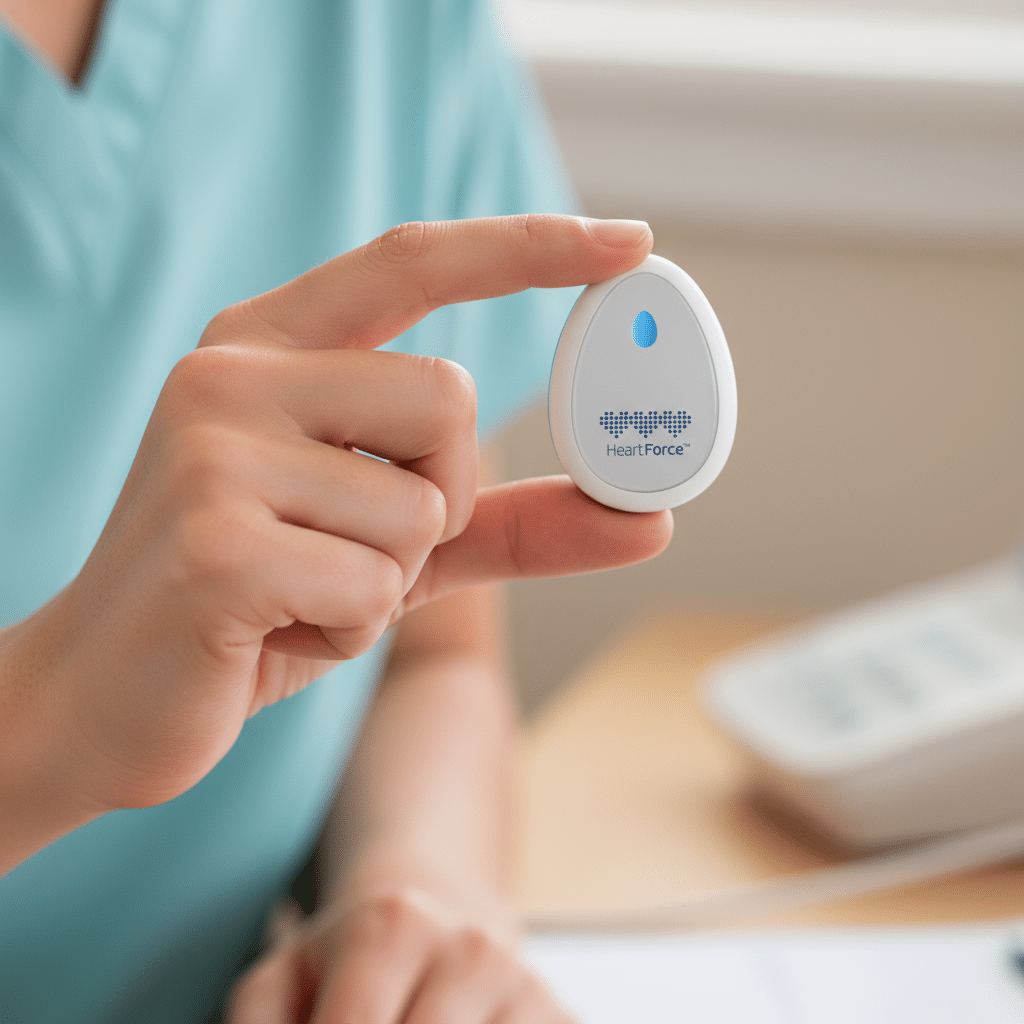
The system includes a compact, non-invasive chest sensor and software interface. It can be run on an Android tablet or smartphone and requires no imaging or laboratory infrastructure.
Is training required to use the CardioClin™ test?
Minimal training is needed. Most clinicians and support staff can begin using CardioClin™ after a short onboarding session or brief tutorial.
Can the CardioClin™ be used in telemedicine or remote settings?
Yes. The portability of CardioClin™ and ease of use make it well-suited for remote care, mobile clinics, and decentralized health programs.
3. Patient Safety & Usability
What is the age range for the intended use of CardioClin™?
For adults aged 40 and above.
Is the CardioClin™ test safe for all patients?
Yes. CardioClin™ is non-invasive, painless, and does not involve radiation or contrast agents, making it safe for a wide range of patients, including those with renal impairment or contraindications to imaging.
Can CardioClin™ be used during pregnancy?
No. CardioClin™ is not intended for use during pregnancy.
Although the device is non-invasive and does not use radiation or electrical stimulation, pregnant individuals were excluded from our clinical studies. As a result, CardioClin™ has not been validated for use during pregnancy and should not be used in this population.
Is the CardioClin™ test affected by body habitus or motion artifacts?
The system uses advanced signal processing to handle mild motion artifacts. However, extreme body motion or severe obesity may reduce signal quality. Proper sensor placement and brief patient stillness optimize performance.
How is patient data protected?
CardioClin™ complies with applicable privacy regulations (e.g., HIPAA, GDPR) and uses secure, encrypted storage and data transfer protocols.
4. Cost & Financial Considerations
What is the upfront cost of the CardioClin™ test?
There is no upfront cost. The CardioClin™ is provided under a loaner agreement. Under this loaner agreement, the device is provided free of charge (FOC); however, a fee will be incurred for each test completed and the number of licenses per healthcare facility. For further information on this loaner agreement, please complete this form and we’ll contact you as soon as possible.
Are there ongoing costs for CardioClin™ (maintenance, software updates, consumables, calibration)?
The only maintenance costs for the CardioClin™ are the ECG electrode patches and a lithium coin battery.
5. Maintenance & Support
What is the expected lifespan of the CardioClin™?
The expected lifespan of the device is 3 years.
How often does CardioClin™ need servicing or calibration?
The device does not require servicing or calibration. If it does not function properly, please contact our customer service team. If the issue cannot be resolved remotely, a replacement device will be provided.
Is it possible to have a demo of the CardioClin™ test?
Yes, you can sign-up for a demo by completing this form, and we’ll contact you as soon as possible.
Is customer support or service support available?
Yes, customer support is available. Please complete this form, and we’ll contact you as soon as possible.
What if my CardioClin ™ is no longer working?
In case your device breaks down, you should contact our service support by completing this form. We will send you a new device and ask you to return the defect device with return instructions and packaging.
6. Patient Experience & Workflow Impact
Will CardioClin™ require significant changes to the clinic’s workflow?
No. CardioClin™ uses information from existing screening protocols and therefore integrates seamlessly. After entering this information into the CardioClin™ application’s patient profile, the test takes approximately 60 seconds to complete. The streamlined process reduces administrative burden and enhances efficiency.
Does CardioClin™ enhance patient care and operational efficiency?
Yes, by significantly reducing false positives compared to current screening methods, the CardioClin™ helps avoid unnecessary follow-up tests that require advanced equipment, specialized staff, and hospital visits. This not only lowers costs but also reduces overall patients stress and discomfort.
Can CardioClin ™ be used to screen individuals without symptoms and that are not aware they are at risk of CAD.
Absolutely, unlike other available screening tests, CardioClin™ can be used and preliminary results show 99% effectiveness in ruling-out CAD for individuals with CAD associated risk factors¹.
Is the CardioClin™ test well-tolerated by patients?
Absolutely. The procedure is non-invasive, painless, and fast, making it suitable for routine visits and easily accepted by patients of all ages and risk profiles.
7. Competitive & Future-Proofing Considerations
Are there upcoming updates or newer CardioClin™ models expected soon?
Yes, the CardioClin™ is part of an evolving platform that benefits from ongoing software enhancements. Future updates focus on expanding diagnostic capabilities and improving predictive performance.
Does the CardioClin™ test utilize AI or machine learning to support diagnostics?
Yes. CardioClin™ leverages a proprietary AI-enabled algorithm that integrates machine learning models trained on cardiac mechanical activity. This allows for adaptive optimization and continuous improvement in diagnostic accuracy over time.
Is the CardioClin™ device future-proof?
HeartForce™ is committed to supporting all current and future CardioClin™ devices through regular AI-driven software updates and machine learning refinements. This ensures clinicians always have access to the most advanced diagnostic insights, without the need for costly hardware upgrades.