
Our Core Technology:
How Seismocardiography (SCG) Enables CAD Risk Identification
Seismocardiography (SCG) is at the heart of HeartForce’s CardioClin™ device. It is a non-invasive technique that measures the micro-vibrations produced by the heart’s mechanical activity as they propagate through the chest wall.
The signal incorporates the vibration that is produced by:
The contraction and relaxation of heart muscles, it captures the kinetic energy and physical recoil generated when the heart muscle contracts, relaxes, and forces blood into the aorta.

However, myocardial motion is the prominent low-frequency vibration since it generates a stronger force during the cardiac cycle. These vibrations travel through the chest wall and can be detected on the surface of the skin, typically on the sternum.
SCG Signal Markers and Clinical Utility
Seismocardiography signals are captured by high-sensitivity sensors placed over the sternum, generating a real-time waveform of cardiac activity. These waveforms provide the foundation for deeper analysis, specifically utilizing accelerometers to measure the underlying SCG signal. Research established that distinct fiducial points within this SCG signal directly correlate with specific events of the cardiac cycle, including the opening (AO) and closure (AC) of the aortic valve. This correlation enables the estimation of systolic and diastolic intervals. Moreover, alterations in the signal morphology have been linked to various cardiac diseases and abnormalities including:
- Coronary artery disease (CAD)
- Heart failure (HF)
- Valvular disease
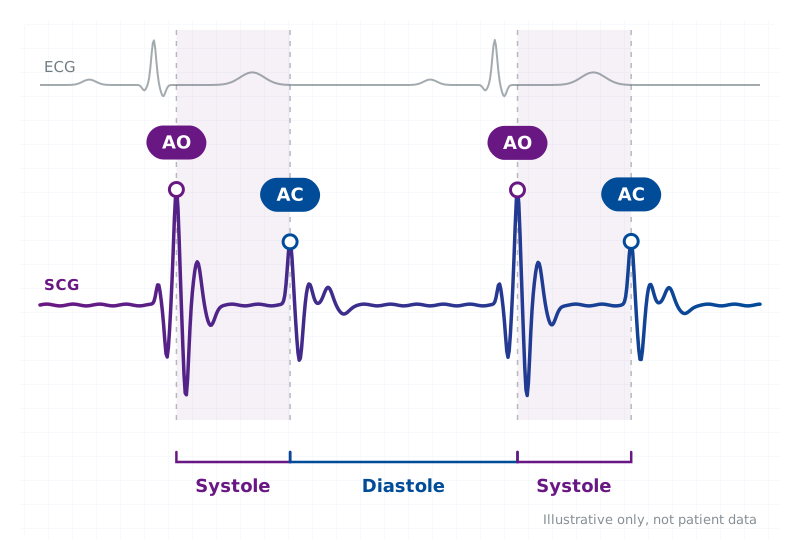
AOAortic valve opening ACAortic valve closure